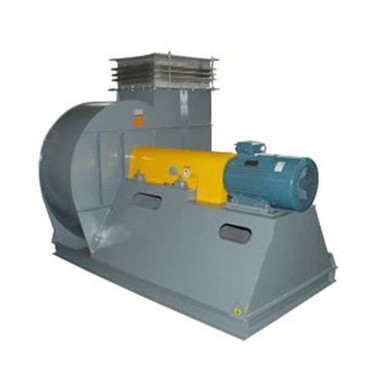
What Causes Excessive Vibration In An Industrial Blower?
Sep 29, 2026
An industrial blower should operate with stable rotation and manageable vibration. When the blower starts shaking, producing unusual noise, or transmitting vibration to its supporting structure, the problem should be investigated before continued operation causes further damage.
Excessive vibration is not a fault by itself. It is a symptom that can come from several different sources, including an unbalanced impeller, damaged bearings, shaft misalignment, loose mounting bolts, or an unstable foundation. Airflow conditions inside the connected ductwork can also contribute to vibration.
The difficulty is that these problems can produce similar symptoms. Replacing a bearing or balancing the impeller without identifying the actual source may not solve the problem.
For maintenance teams, the important task is to determine where the vibration originates, under what operating conditions it occurs, and whether it is caused by a rotating component, the supporting structure, or the airflow system.
1. Impeller Imbalance Caused by Dust Build-Up or Blade Damage
Impeller imbalance is one of the most common causes of industrial blower vibration.
A centrifugal blower impeller rotates at high speed. If its mass is not evenly distributed around the rotational axis, centrifugal forces develop during operation. These forces are transmitted through the shaft and bearings to the blower housing and foundation.
In industrial environments, imbalance may develop even if the impeller was correctly balanced before delivery.
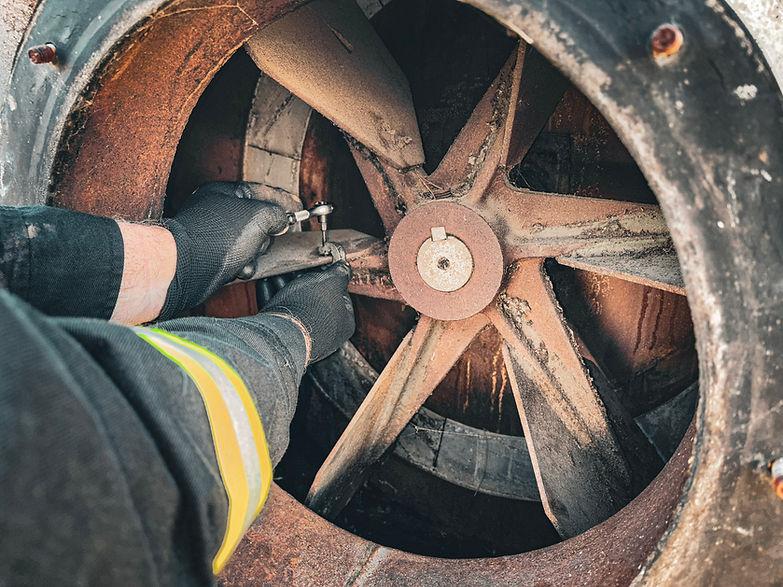
Dust, fibers, oil deposits, and other process materials can accumulate unevenly on the blades. Abrasive particles may wear certain areas more quickly, while corrosion or physical damage can change the original impeller geometry.
A blower used for dust collection, woodworking, cement handling, or material conveying may therefore develop vibration after an extended period of operation.
What to check:
Inspect the impeller for uneven deposits on the blades.
Look for erosion, corrosion, cracks, and deformation.
Check whether any balancing weights have become loose or detached.
Compare vibration readings with previous maintenance records.
Check whether vibration increased after cleaning, repair, or impeller replacement.
If the impeller is dirty, cleaning may restore its original balance condition. If the blades have been damaged or material has been removed unevenly, professional inspection and dynamic balancing may be required.
Adding balancing weights without confirming the cause is not a reliable repair method.
2. Bearing Wear or Bearing Installation Problems
Bearings support the rotating shaft and maintain the correct position of the impeller. When a bearing becomes worn, contaminated, improperly lubricated, or incorrectly installed, it may generate additional vibration.
Early warning signs can include unusual noise, increasing bearing temperature, and changes in vibration readings. As damage progresses, the bearing may develop excessive clearance or rough rolling surfaces.
However, not every vibration problem near a bearing housing means the bearing itself has failed.
Excessive belt tension, shaft misalignment, rotor imbalance, and incorrect bearing installation can all place additional loads on the bearing. If these conditions are not corrected, a replacement bearing may fail again.
What to check:
Measure vibration at both bearing housings.
Check bearing temperature under comparable operating conditions.
Listen for grinding, rattling, or irregular running noise.
Inspect lubrication condition and relubrication records.
Check bearing mounting bolts and shaft alignment.
If a bearing repeatedly fails, investigate the surrounding mechanical system instead of treating each replacement as an independent repair.
3. Shaft and Drive Misalignment
Misalignment occurs when connected rotating components are not positioned correctly relative to each other.
In a direct-driven blower, the motor shaft and blower shaft must be aligned according to the coupling manufacturer's requirements. Angular or parallel misalignment can create additional forces during rotation.
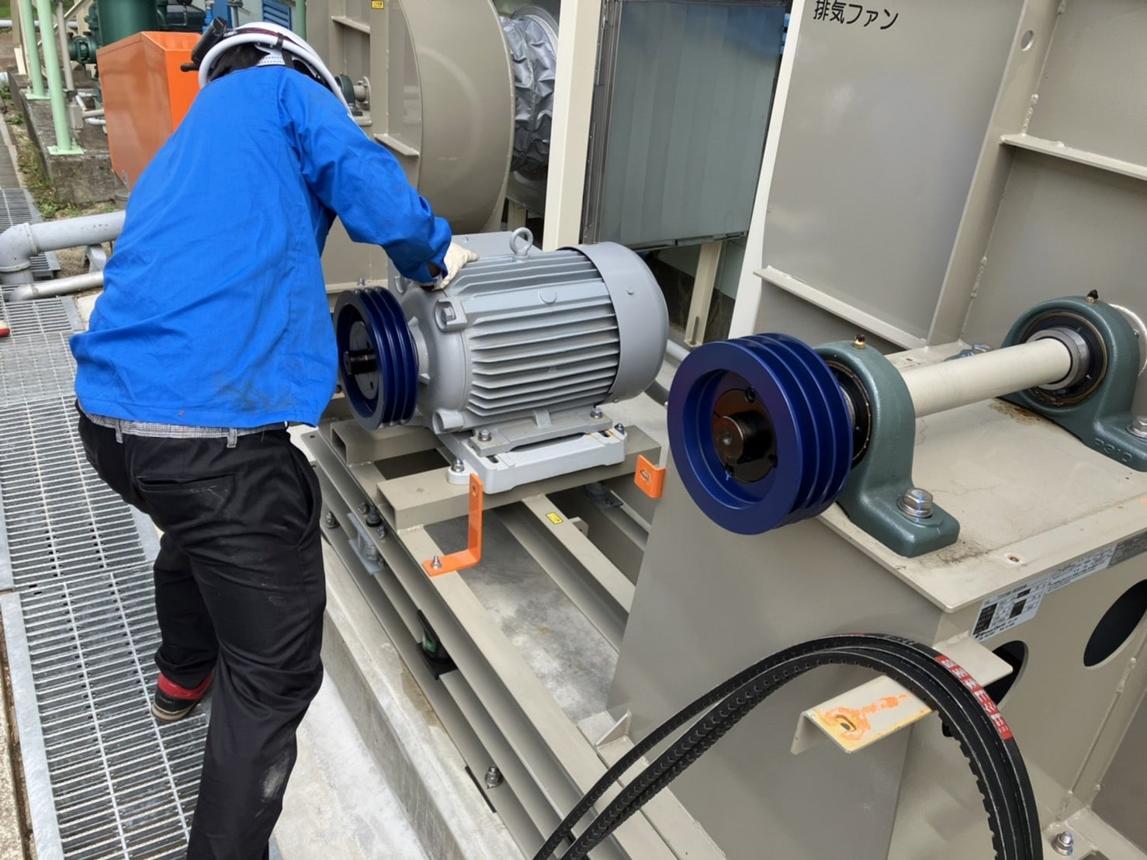
For belt-driven blowers, the motor and blower pulleys must be correctly aligned. Incorrect pulley positioning can cause uneven belt loading and vibration.
Misalignment may also develop after maintenance, bearing replacement, motor removal, or changes to the supporting base.
A useful diagnostic clue is vibration in the axial direction, meaning vibration parallel to the shaft. Significant axial vibration can be associated with misalignment, although resonance, bearing problems, and structural weakness can produce similar symptoms.
What to check:
Inspect coupling condition and alignment on direct-driven units.
Check pulley alignment on belt-driven units.
Look for uneven belt wear and abnormal belt movement.
Inspect shaft and coupling components for damage.
Recheck alignment after replacing bearings or moving the motor.
Alignment should be measured using suitable tools rather than estimated by eye. Correcting alignment can reduce unnecessary mechanical loading and help extend bearing and coupling service life.
4. Loose Bolts, Weak Foundations, and Structural Resonance
Sometimes the blower's rotating components are in reasonable condition, but the supporting structure is unable to control the forces generated during operation.
Loose anchor bolts, cracked welds, damaged base frames, deteriorated vibration isolators, and uneven mounting surfaces can all contribute to excessive vibration.
A weak support structure may amplify otherwise manageable vibration. This can make the blower appear to have a serious internal mechanical problem even when the original excitation comes from the foundation or installation.
Structural resonance is a more specific condition. It occurs when an excitation frequency approaches a natural frequency of the blower, base, or connected structure. The vibration response can then increase significantly at certain operating speeds.
This explains why a blower may vibrate heavily at one speed but operate more smoothly at another.
What to check:
Inspect anchor bolts, foundation bolts, and mounting connections.
Look for cracks in the base frame, grout, or supporting structure.
Check whether vibration isolators are damaged or incorrectly installed.
Inspect whether connected ducts or pipes are placing additional loads on the blower casing.
Observe whether vibration changes significantly during acceleration or deceleration.
If resonance is suspected, a vibration specialist can compare vibration amplitude and frequency during run-up and coast-down. Simply tightening bolts or adding thicker support plates may not resolve the problem if the underlying structural frequency remains unchanged.
5. Incorrect Belt Tension and Unbalanced Drive Components
For belt-driven industrial blowers, the drive system can be a separate source of vibration.
Belts that are too loose may slip or move unevenly. Belts that are too tight can create excessive radial loads on the shafts and bearings.
Worn pulleys, eccentric sheaves, mismatched belts, and loose locking components can also create periodic forces during rotation.
These problems are sometimes overlooked because maintenance teams focus on the blower impeller rather than the motor and transmission system.
What to check:
Inspect belts for cracking, glazing, and uneven wear.
Confirm that all belts in a multi-belt drive are correctly matched.
Check pulley alignment and groove condition.
Measure belt tension according to the manufacturer's instructions.
Inspect pulley hubs, keys, and locking devices.
Do not tighten a belt simply because the blower is vibrating. Excessive tension can make bearing damage worse.
6. Foreign Objects or Internal Contact Inside the Blower
Foreign objects entering the blower can cause sudden vibration or damage to the impeller.
In industrial applications, this may happen when loose metal fragments, process debris, broken filter components, or other materials pass through the inlet.
An object trapped between the impeller and housing can create an imbalance or cause mechanical contact. Damaged blade edges and rubbing between rotating and stationary components may also generate unusual noise.
A related problem occurs when the impeller shifts because of shaft movement, incorrect installation, or bearing damage. The rotating wheel may then contact the inlet cone or housing.
What to check:
Inspect the inlet screen and upstream equipment.
Check the impeller for foreign objects and impact damage.
Look for rubbing marks on the housing or inlet cone.
Check the impeller-to-inlet clearance against the manufacturer's drawings.
Investigate whether the shaft or bearing position has changed.
If rubbing, impact, or abnormal internal contact is suspected, stop the blower and isolate the power supply before inspection. Do not continue running the equipment in an attempt to see whether the noise disappears.
7. Unstable Airflow and Poor Inlet or Outlet Conditions
Not all blower vibration originates from mechanical components.
Uneven airflow, inlet swirl, flow separation, and unstable operating conditions can generate fluctuating aerodynamic forces on the impeller and housing.
This may occur when an elbow is installed too close to the blower inlet, the inlet is partially obstructed, or the outlet duct arrangement creates unfavorable flow conditions.
A blower operating under unstable system conditions may also produce fluctuating pressure and noise. In some installations, duct vibration can be transmitted back to the blower and its support structure.
What to check:
Inspect the inlet for obstructions and uneven airflow.
Check whether an elbow or transition is installed too close to the inlet.
Review damper positions and operating conditions.
Inspect duct supports and flexible connections.
Compare vibration with changes in airflow, pressure, and operating speed.
If vibration changes with damper position or process airflow, investigate the system conditions as well as the blower itself. Do not assume that the impeller or bearings must be replaced.
8. How to Identify the Actual Source of Blower Vibration
Because several faults can produce similar symptoms, visual inspection alone may not be enough.
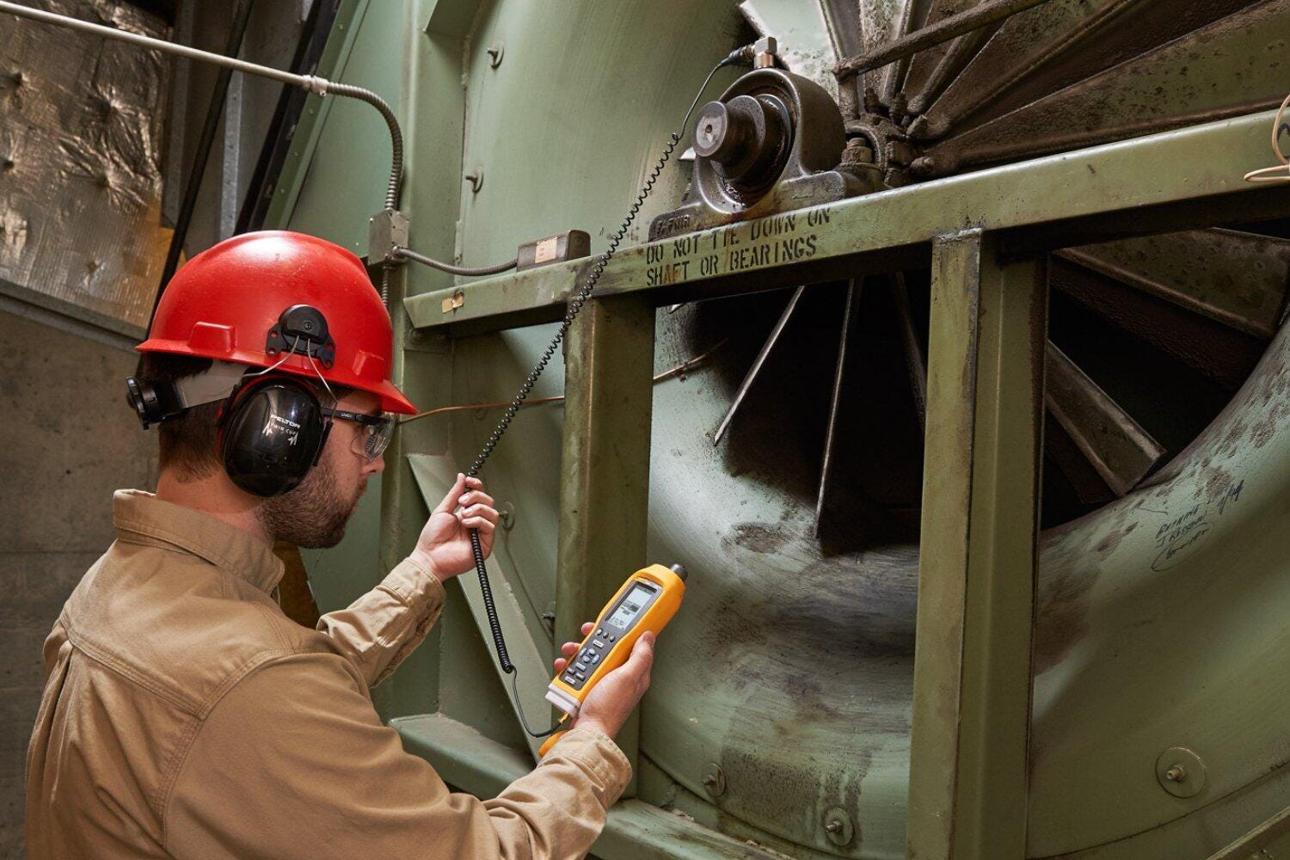
A more reliable diagnosis combines vibration measurements with mechanical inspection and operating records.
| Observation | Possible Cause | Recommended Check |
|---|---|---|
| Vibration increases with rotational speed | Impeller imbalance, bent shaft, or other rotating fault | Impeller condition, shaft runout, vibration spectrum |
| Abnormal axial vibration | Misalignment or structural weakness | Coupling alignment and bearing support |
| Vibration changes significantly at a particular speed | Structural resonance | Run-up and coast-down vibration analysis |
| Vibration increases with bearing temperature and noise | Bearing deterioration | Lubrication, bearing condition, mounting |
| Sudden vibration after maintenance | Incorrect assembly, alignment, or loose components | Recent installation and maintenance work |
| Vibration changes with airflow or damper position | Aerodynamic or system-related instability | Inlet, outlet, and duct conditions |
These are diagnostic clues rather than definitive fault identifications. For example, vibration at the rotational frequency can be associated with imbalance, but it can also result from a bent shaft, eccentric pulley, misalignment, or resonance.
Where the cause is unclear, frequency-spectrum analysis and measurements at multiple locations can help distinguish between these conditions.
9. What Should You Do When an Industrial Blower Starts Vibrating?
A practical troubleshooting process should begin with the change in operating condition, not immediate component replacement.
Step 1: Determine when the vibration started.
Check whether it appeared during initial commissioning, after maintenance, following a process change, or gradually during normal operation. This history can narrow down the likely causes.
Step 2: Record the operating conditions.
Note blower speed, airflow, pressure, motor current, bearing temperature, and vibration readings. Measurements should be taken at consistent locations and under comparable operating conditions.
Step 3: Inspect accessible mechanical components.
After safely isolating the equipment, inspect the impeller, shaft, bearings, coupling or belt drive, mounting bolts, and internal clearances.
Step 4: Check the foundation and duct connections.
Look for loose supports, damaged isolators, structural cracks, and excessive loads from connected ductwork.
Step 5: Use vibration analysis when necessary.
If basic inspection does not identify the cause, qualified personnel can perform vibration spectrum analysis and other diagnostic tests. This is particularly important when resonance, shaft problems, or multiple vibration sources are suspected.
Do not continue operating a blower with severe or rapidly increasing vibration, abnormal rubbing, visible structural damage, or signs of imminent mechanical failure. Follow the manufacturer's shutdown limits and the site's safety procedures.
How Can Industrial Blower Vibration Be Prevented?
Preventing excessive vibration requires attention to the complete blower installation, not just the rotating assembly.
For dust-handling applications, regular impeller inspection helps prevent uneven material build-up. For belt-driven blowers, pulley alignment and correct belt tension should be checked during maintenance. Bearing condition, foundation integrity, and duct connections also need periodic inspection.
For new installations, the following points are important:
Select a blower suitable for the actual airflow and pressure requirements.
Provide a stable foundation with appropriate support and isolation.
Follow the manufacturer's inlet and outlet connection recommendations.
Check impeller balance and shaft alignment before commissioning.
Record baseline vibration readings after installation.
Establish inspection intervals based on operating hours and environmental conditions.
Vibration limits should be selected according to the applicable fan classification, mounting arrangement, and relevant standards. A single vibration value should not be applied to every industrial blower.
Conclusion
Excessive vibration in an industrial blower can result from impeller imbalance, bearing deterioration, shaft misalignment, incorrect belt tension, loose foundations, internal contact, or unstable airflow conditions.
The key is to identify whether the vibration originates from the rotating assembly, drive system, supporting structure, or connected ductwork. Replacing a bearing or balancing an impeller without confirming the cause may leave the original problem unresolved.
At Wuxi JN Fan Factory, blower selection and installation need to account for operating conditions, transported materials, drive arrangements, and supporting structures. Proper matching and commissioning, combined with regular condition monitoring, help reduce vibration-related maintenance problems and support reliable industrial operation.