


Why Does A Centrifugal Fan Vibrate During Operation?
Oct 29, 2026
A centrifugal fan produces some vibration during operation. The rotating impeller, motor, shaft, bearings, and airflow all generate forces that are transferred through the fan casing and supporting structure.
However, vibration becomes a problem when its level increases, changes suddenly, or is accompanied by unusual noise, bearing temperature, or unstable airflow.
The important point is that not all centrifugal fan vibration comes from an unbalanced impeller. Mechanical components, airflow conditions, foundation rigidity, and installation errors can all contribute. Replacing the bearing or balancing the impeller without identifying the actual source may not solve the problem.
For maintenance engineers, the first step is to determine where the vibration originates and whether it is related to fan rotation, airflow, or the supporting structure.
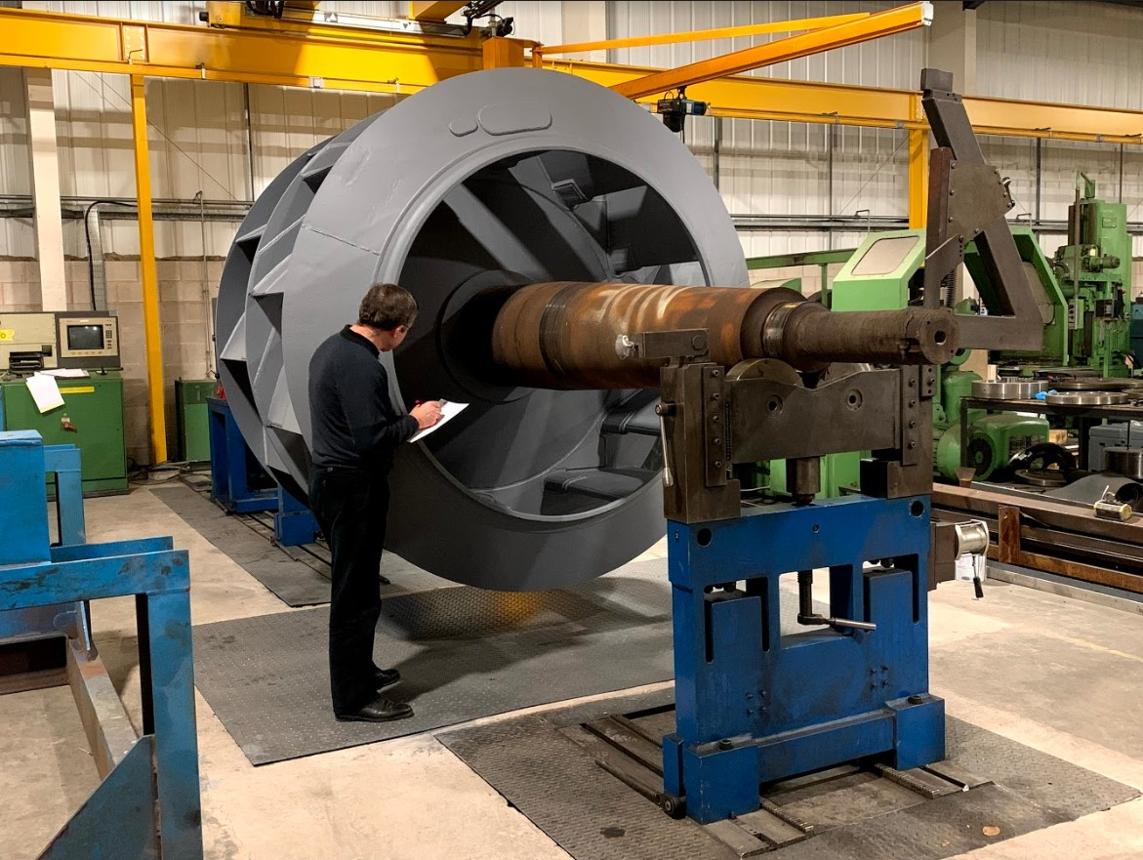
1. Impeller Imbalance Creates Rotating Forces
Impeller imbalance is one of the most common mechanical causes of centrifugal fan vibration.
When the impeller's mass is not evenly distributed around its rotational axis, centrifugal force develops as it rotates. This force is transmitted through the shaft and bearings to the fan casing and foundation.
Imbalance can occur for several reasons:
Dust or process material accumulates unevenly on the blades.
Blade surfaces become corroded or eroded.
A blade is bent or damaged by foreign objects.
Balance weights become loose or are missing.
The impeller is incorrectly assembled or repaired.
In dust collection and material handling applications, material build-up is particularly important. Even a relatively small amount of unevenly distributed material can affect the balance of a high-speed impeller.
How to identify it: Vibration caused by rotating imbalance often has a strong component at the fan's rotational frequency, commonly called 1× running speed. However, this is a diagnostic indication rather than definitive proof. Other mechanical conditions can also produce vibration at similar frequencies.
Inspect the impeller for deposits, damage, and signs of contact with the casing. If cleaning or repair is necessary, check the balance according to the manufacturer's requirements before returning the fan to operation.
2. Bearing Wear Allows Excessive Shaft Movement
The bearings support the rotating shaft and maintain the impeller's position during operation. When a bearing becomes damaged or loses its proper operating condition, the shaft may no longer rotate smoothly.
This can produce vibration, noise, and additional heat.
Common bearing-related causes include:
Insufficient or excessive lubrication.
Contamination from dust, moisture, or process particles.
Bearing fatigue or surface damage.
Incorrect bearing installation.
Excessive radial or axial loading.
Shaft misalignment.
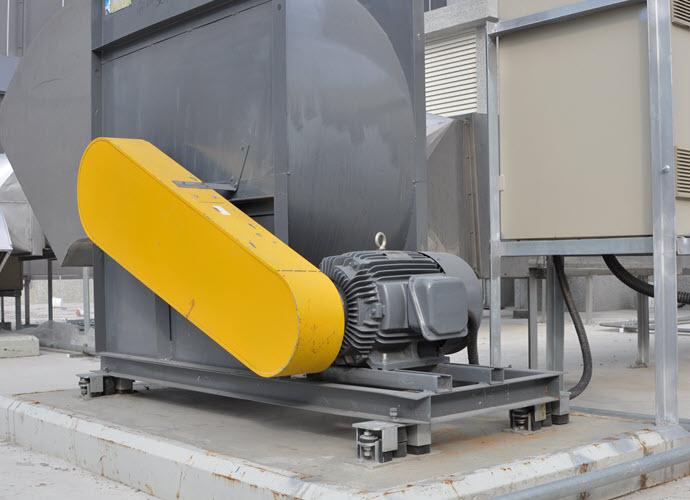
For belt-driven centrifugal fans, excessive belt tension can place additional radial load on the fan shaft bearings. The problem may therefore originate from the drive arrangement rather than the bearing itself.
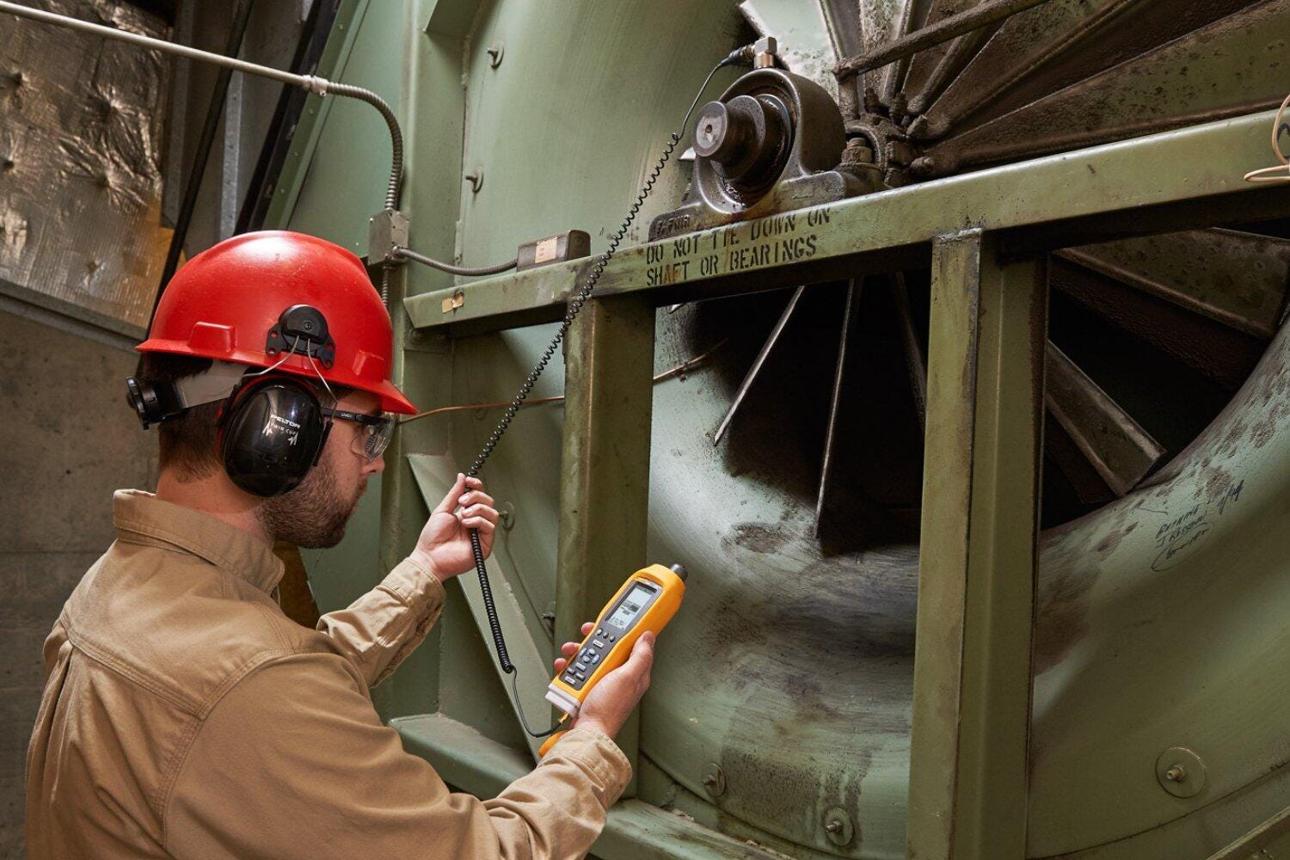
How to identify it: Check vibration near the bearing housing and compare it with measurements at the motor and fan casing. Monitor bearing temperature and listen for unusual rumbling or grinding sounds.
Bearing defects may produce characteristic vibration frequencies related to the rolling elements, raceways, and cage. A vibration spectrum can help identify these patterns when interpreted by a qualified technician.
Do not assume that adding grease will correct every bearing vibration problem. A physically damaged bearing normally requires replacement, while lubrication must follow the bearing manufacturer's instructions.
3. Shaft Misalignment Causes Unstable Rotation
In direct-drive or coupling-driven centrifugal fans, poor alignment between the motor shaft and fan shaft can create additional mechanical forces.
Misalignment may develop during installation, after maintenance, or when the base shifts under operating loads.
There are two common forms:
Angular misalignment: The shaft centerlines meet at an angle.
Parallel misalignment: The shaft centerlines are offset but remain approximately parallel.
Both conditions can increase vibration and place additional loads on bearings and couplings.
For belt-driven fans, the equivalent alignment issue is often found between the motor and fan pulleys. Misaligned pulleys can cause uneven belt loading, additional shaft forces, and premature belt wear.
How to identify it: Inspect the coupling or pulley alignment using an appropriate alignment method. Check whether the base, mounting bolts, and shaft positions have changed since installation.
Correct alignment according to the equipment manufacturer's tolerances. Tightening the coupling or adjusting the belt without checking alignment can leave the underlying problem unresolved.
4. Loose Foundations and Structural Resonance Amplify Vibration
A centrifugal fan can vibrate more than expected even when its rotating components are in acceptable condition.
The reason may be the supporting structure.
If the foundation, steel frame, mounting bolts, or bearing supports are insufficiently rigid, the structure may move in response to the forces generated by the rotating equipment.
Resonance is another possible cause. When an excitation frequency from the fan or motor approaches a natural frequency of the supporting structure, vibration can be amplified.
Typical warning signs include:
The fan base moves noticeably during operation.
Vibration is stronger on the support frame than on the fan casing.
The ductwork vibrates together with the fan.
Vibration changes significantly within a narrow speed range.
A new vibration appears after the equipment is installed on a different foundation.
How to identify it: Measure vibration at several locations, including the bearing supports, casing, base, and connected structure. If the support frame shows a much stronger response than the bearing housing, investigate the foundation and structural arrangement.
Simply tightening mounting bolts is not always the answer. The support may require additional stiffness, improved anchoring, or a different vibration-isolation arrangement.
5. Airflow Disturbance Creates Aerodynamic Vibration
Not all vibration is caused by mechanical defects. Unstable airflow can also generate fluctuating forces inside a centrifugal fan.
This is particularly relevant when the inlet or outlet duct arrangement does not provide suitable flow conditions.
Examples include:
An inlet elbow positioned too close to the fan.
Uneven airflow entering the impeller.
Swirling flow caused by poor inlet geometry.
A restricted inlet or outlet.
An unsuitable damper position.
Operation near an unstable region of the fan performance curve.
When airflow is uneven, the impeller may experience fluctuating aerodynamic forces. These forces can be transmitted to the casing and supporting structure.
In some operating conditions, the fan may also experience stall-related instability, producing pressure pulsations, noise, and vibration.
How to identify it: Compare vibration and noise at different operating points while monitoring airflow and static pressure. If the vibration changes substantially with damper position or airflow, investigate the system resistance and inlet/outlet arrangement.
Do not automatically increase fan speed to compensate for low airflow. If the underlying problem is poor inlet flow or an unsuitable operating point, increasing speed may make the vibration and mechanical loading worse.
6. Belt Drive Problems Cause Periodic Vibration
Belt-driven centrifugal fans require correct belt tension and pulley alignment. If either is incorrect, the drive system can introduce additional vibration.
Common problems include:
Belt tension that is too high.
Belt tension that is too low.
Uneven belt wear.
Damaged or eccentric pulleys.
Incorrect pulley alignment.
A damaged belt joint or surface.
Differences in length or condition between multiple belts.
A loose belt may slip or produce periodic movement. An excessively tight belt increases radial loading on the motor and fan bearings.
How to identify it: Inspect the belt condition, pulley alignment, and tension after isolating the equipment. If the vibration is concentrated around the drive assembly, inspect these components before replacing the fan bearings.
For multi-belt drives, belts should be selected and maintained as a matched set where required by the drive manufacturer.
7. Foreign Objects or Internal Contact Cause Abnormal Vibration
A foreign object entering the fan can damage the impeller or become trapped inside the casing.
Examples include loose fasteners, broken material, packaging fragments, metal pieces, and process debris.
Another possibility is internal contact between the impeller and casing. This may happen because of shaft movement, bearing damage, incorrect assembly, thermal expansion, or deformation.
The resulting vibration may be accompanied by scraping, knocking, or sudden changes in operating sound.
How to identify it: Stop the fan if there is evidence of internal contact, impact, or sudden abnormal vibration. After isolating the equipment, inspect the impeller, inlet cone, casing, and internal clearances.
Do not continue running the fan to see whether the noise disappears. Contact between rotating components can cause further damage.
8. How to Identify Where Centrifugal Fan Vibration Comes From
A useful vibration diagnosis requires measurements at more than one location.
Measuring only the motor casing may not reveal whether the problem originates from the motor, fan shaft, bearing support, or foundation.
The following table provides a practical starting point.
| Measurement location | What to investigate | Possible source |
|---|---|---|
| Motor bearing housing | Vibration and bearing temperature | Motor bearing, rotor, electrical or alignment problems |
| Fan bearing housing | Radial and axial vibration | Fan bearing, shaft, impeller imbalance |
| Fan casing | Overall vibration and local movement | Impeller forces, aerodynamic excitation, casing resonance |
| Motor and fan base | Structural movement | Loose mounting, weak foundation, resonance |
| Inlet and outlet ducts | Vibration related to airflow | Aerodynamic forces and transmitted vibration |
| Coupling or belt drive | Periodic vibration and movement | Misalignment, belt problems, eccentric pulleys |
For a more detailed investigation, use vibration analysis to examine:
Frequency: Whether the vibration occurs at running speed or at other characteristic frequencies.
Amplitude: Whether vibration is increasing over time or exceeds the applicable acceptance criteria.
Direction: Whether vibration is mainly horizontal, vertical, or axial.
Operating condition: Whether vibration changes with fan speed, airflow, or process load.
Measurements should be taken at consistent locations and directions so that results can be compared over time.
A single vibration reading cannot identify every fault. Frequency analysis, phase measurements, and operating-condition comparisons may be needed for more complex cases.
9. What Should You Do When a Centrifugal Fan Starts Vibrating?
When vibration appears during operation, follow a controlled inspection process instead of immediately replacing components.
Step 1: Check whether the vibration is new or gradually increasing.
Compare the current condition with previous inspection records. A sudden change may indicate impeller damage, internal contact, a loose component, or a change in the operating system. Gradual increases may be associated with bearing deterioration, material build-up, or progressive structural problems.
Step 2: Inspect external mechanical components.
After isolating the fan, check the mounting bolts, belt drive, coupling, guards, and accessible fasteners. Look for looseness, wear, and signs of movement.
Step 3: Inspect the impeller and bearings.
Check for uneven deposits, damaged blades, bearing wear, and internal contact. Follow the manufacturer's procedures for removing access covers and inspecting rotating components.
Step 4: Check the inlet and outlet system.
Look for restrictions, unsuitable elbow positions, damper changes, and unstable airflow conditions. Compare the operating point with the fan performance curve.
Step 5: Measure vibration at multiple locations.
Record readings at the motor and fan bearing housings, casing, and support structure. Use frequency analysis if the source is not obvious.
Step 6: Correct the identified cause and verify the result.
After cleaning, balancing, alignment, bearing replacement, or structural repair, repeat the measurements under comparable operating conditions.
If vibration is severe, rapidly increasing, or accompanied by scraping, impact noise, smoke, or abnormal bearing temperature, stop the fan and arrange an inspection before restarting it.
Conclusion
A centrifugal fan may vibrate during operation because of impeller imbalance, bearing deterioration, shaft misalignment, loose foundations, belt-drive problems, aerodynamic instability, or internal contact.
The correct troubleshooting method is to identify where the vibration is strongest, examine its frequency and direction, and compare the results with the fan's operating conditions.
For industrial applications, vibration should be considered together with fan speed, airflow, static pressure, drive arrangement, and installation structure. Treating these factors as one system makes it easier to identify the real cause and avoid repeated repairs.
At Wuxi JN Fan Factory, selecting and configuring a centrifugal fan requires consideration of the operating duty, impeller arrangement, drive system, and installation conditions. Providing the required airflow, pressure, operating speed, and site layout helps establish a suitable fan configuration for the application.
You Might Also Like
-

Industrial Extractor Fan Forward Curved Centrifugal Fan
-

Industrial Roof Ventilation Electric Roof Fan
-
SWF Mixed Circulation Flow Fan
-

Cement Mill Blower Forced Ventilation Centrifugal Fan Sme...
-

110kw High Pressure Centrifugal Blower Boiler Fan
-

Cowper blast air heater used Single Inlet Industrial Boil...