


What Causes Bearing Failure in Industrial Fans?
Sep 15, 2026
Bearing failure is one of the most disruptive problems in industrial fan operation. A damaged bearing can cause excessive vibration, abnormal noise, rising operating temperature, and eventually an unexpected shutdown. In applications such as dust collection, industrial exhaust, material handling, and process ventilation, this can interrupt production even when the fan impeller and motor are otherwise in good condition.
However, a failed bearing is not always the original cause of the problem. In many cases, the bearing is damaged by another condition, such as incorrect lubrication, excessive belt tension, shaft misalignment, or contamination entering the bearing housing.
Replacing the bearing without correcting the underlying cause may only result in another failure after the fan returns to service.
This article explains the main causes of industrial fan bearing failure, how to recognize the warning signs, and what maintenance teams should check before installing a replacement.
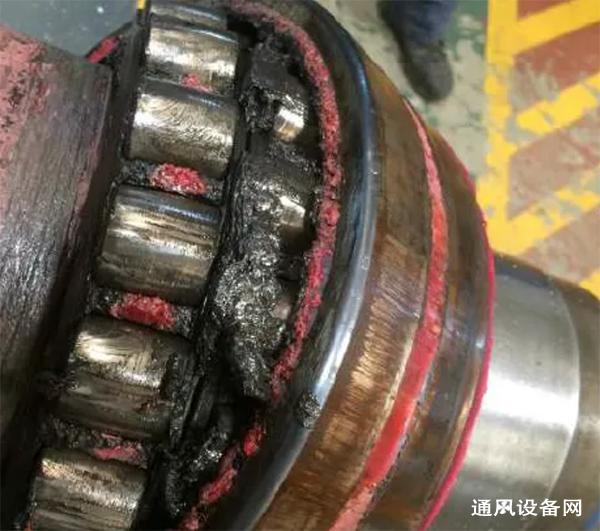
1. Incorrect Lubrication: Too Much or Too Little Grease
Lubrication problems are among the most common reasons for premature bearing failure.
A rolling bearing needs an appropriate lubricant film between its rolling elements and raceways. When the lubricant is insufficient or has deteriorated, friction increases and the bearing surfaces begin to wear.
Under-lubrication may occur when maintenance intervals are too long, grease passages are blocked, or lubricant gradually leaks from the housing. The bearing may develop a rough running sound, increasing temperature, and visible wear.
Over-lubrication is also a problem. Adding excessive grease can cause the rolling elements to churn through the lubricant, generating additional heat. Excess pressure during greasing may also damage seals or force grease into unwanted areas.
Another frequent mistake is using the wrong grease or mixing incompatible grease types. Different thickener systems and lubricant formulations are not necessarily compatible. Mixing them can affect consistency and lubrication performance.
What to check:
Review the bearing manufacturer's specified grease type and relubrication interval.
Check whether grease is leaking, hardened, discolored, or contaminated.
Inspect grease fittings and lubrication passages for blockage.
Confirm whether the bearing is designed for relubrication or is permanently sealed.
Check whether the correct amount of grease is being added.
Do not apply a universal greasing interval to every industrial fan. The correct interval and quantity depend on bearing design, speed, operating temperature, load, and working environment.
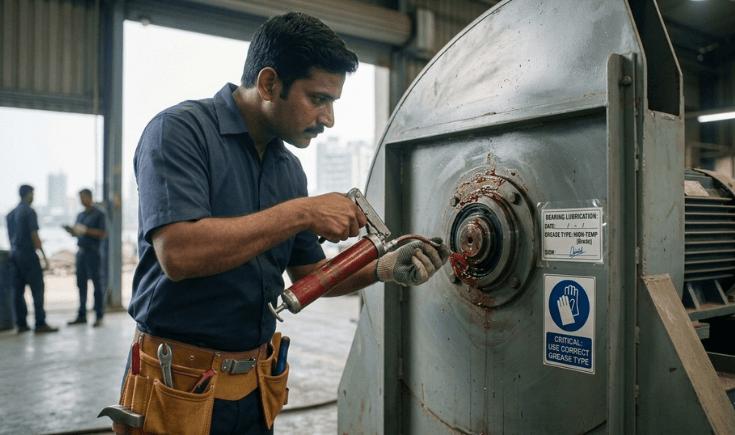
2. Dust, Moisture, and Other Contaminants Entering the Bearing
Industrial fans often operate in environments containing dust, fibers, oil mist, water vapor, or corrosive gases. If contaminants pass through damaged seals or enter during maintenance, they can gradually damage the bearing's internal surfaces.
Fine particles may mix with grease and act as abrasive material between rolling elements and raceways. Moisture can cause corrosion, while chemical contaminants may accelerate lubricant deterioration.
This problem is particularly important for centrifugal fans used in cement production, woodworking, metal processing, and chemical plants.
A bearing may continue operating for some time after contamination begins. Maintenance personnel may first notice dark or dirty grease, unusual noise, or increasing vibration rather than an obvious mechanical failure.
What to check:
Inspect bearing seals and shaft sealing arrangements.
Look for dust accumulation around the bearing housing.
Check whether water can enter during cleaning or from nearby equipment.
Examine removed grease for particles, discoloration, or signs of water contamination.
Confirm that lubrication equipment and grease fittings are kept clean.
For fans handling abrasive or corrosive air, bearing protection should be considered during equipment selection, not only after a failure occurs.
3. Excessive Belt Tension Overloads the Bearings
In belt-driven industrial fans, incorrect belt tension can directly affect bearing service life.
If the belts are tightened too much, the drive creates excessive radial load on the fan shaft. The bearings must continuously support this additional load, which can accelerate fatigue and increase operating temperature.
The problem may develop after routine maintenance. For example, a technician may tighten the belts to eliminate slipping without checking the manufacturer's tension requirements. The fan may initially appear to run more smoothly, but the increased bearing load can shorten its service life.
Belt misalignment can create additional forces and vibration. Worn pulleys or mismatched belts may also cause uneven loading.
What to check:
Measure belt tension using the recommended method.
Check whether motor and fan pulleys are aligned.
Inspect belts for cracking, glazing, and uneven wear.
Check pulley grooves and shaft connections.
Replace multiple belts as a matched set where required by the drive design.
If a bearing repeatedly fails on a belt-driven fan, check the drive system before installing another bearing.
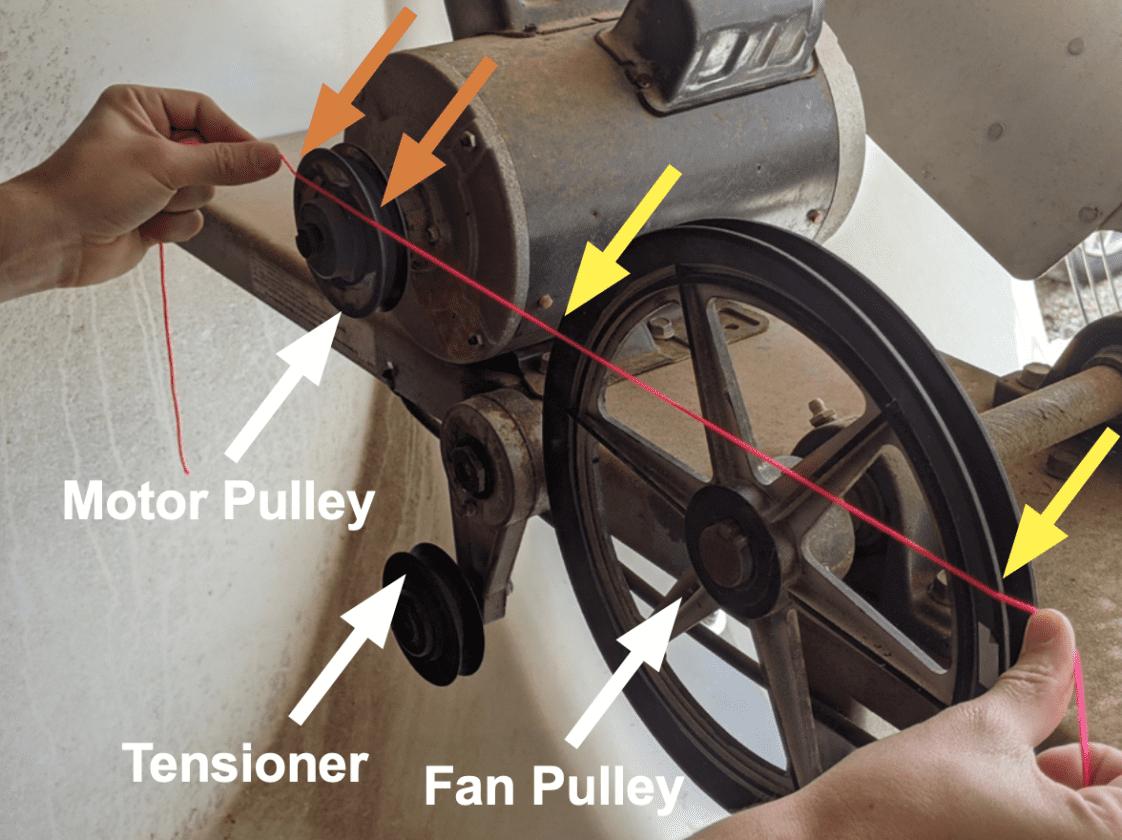
4. Shaft Misalignment and Improper Bearing Installation
A bearing must be correctly positioned and supported to operate under its intended load.
If the fan shaft, bearing housings, or coupling are misaligned, the bearing may experience uneven loading. This can cause localized wear, abnormal temperature, and vibration.
Installation errors can create similar problems. Examples include incorrect bearing fits, damaged seals, improper locking arrangements, contaminated mounting surfaces, and uneven tightening of housing bolts.
Another condition worth checking is soft foot. This occurs when the equipment feet do not sit evenly on the mounting surface. Tightening the mounting bolts can distort the machine frame or affect alignment.
These problems may be present from the first start-up, which explains why some industrial fan bearings fail much earlier than expected.
What to check:
Verify shaft and coupling alignment.
Inspect bearing housing mounting surfaces and fasteners.
Check for soft foot or an uneven support base.
Confirm the bearing fit and locking arrangement.
Inspect the shaft journal for wear, damage, or dimensional problems.
Bearing replacement should follow the bearing and fan manufacturer's installation instructions. For critical equipment, alignment and installation should be checked with suitable measuring tools rather than visual estimation alone.
5. Impeller Imbalance and Excessive Fan Vibration
A fan bearing is continuously exposed to forces generated by the rotating assembly. If the impeller becomes unbalanced, these forces can increase significantly.
Dust build-up on one side of the impeller, uneven blade erosion, corrosion, physical damage, or loose components can shift the rotor's balance.
The resulting vibration is transmitted through the shaft to the bearing housings. If the fan continues operating with excessive vibration, bearing fatigue and other mechanical damage may develop.
It is important to understand that vibration does not automatically mean the bearing itself is defective. An unbalanced impeller, bent shaft, loose mounting bolts, or structural resonance can produce similar symptoms.
What to check:
Inspect the impeller for uneven dust deposits and material build-up.
Look for worn, corroded, cracked, or damaged blades.
Check shaft condition and impeller mounting.
Measure vibration at consistent locations on the bearing housing.
Compare readings with previous inspection records.
If the impeller has been cleaned, repaired, or replaced, its balance should be verified before the fan returns to normal operation.
6. Excessive Temperature and Unsuitable Operating Conditions
Industrial fan bearings are affected by both mechanical loading and operating temperature.
When a fan handles high-temperature gas, heat can transfer through the shaft and bearing support structure. High ambient temperatures can also affect bearing cooling and lubricant performance.
If the lubricant operates beyond its suitable temperature range, its properties may deteriorate more quickly. This increases friction and can accelerate bearing wear.
Other conditions that may contribute to overheating include excessive speed, incorrect bearing selection, insufficient lubrication, and excessive mechanical load.
A temperature increase should therefore be investigated rather than treated as an isolated issue.
What to check:
Record bearing housing temperature under comparable operating conditions.
Compare the readings with previous measurements and manufacturer limits.
Check whether process gas or ambient temperature has changed.
Verify fan speed and operating load.
Review lubricant suitability for the actual temperature range.
Do not judge bearing condition by touching the housing. Use a suitable contact thermometer or infrared measuring instrument and compare readings over time.
7. Electrical Current Passing Through Motor Bearings
On variable-frequency-drive (VFD) applications, electrical discharge through motor bearings can be another possible failure mechanism.
Depending on the motor, drive, grounding arrangement, and installation, shaft voltage may discharge through the bearing contact surfaces. Repeated electrical discharges can damage the raceways and create a fluted or corrugated surface pattern.
This issue concerns the electric motor bearings rather than automatically indicating a failure of the fan-side shaft bearings.
If a motor bearing fails repeatedly on a VFD-driven fan, replacing the bearing alone may not solve the problem. The electrical system should be checked by qualified personnel for shaft voltage, grounding, and suitable bearing protection.
8. How to Identify the Cause Before Replacing a Bearing
A failed bearing should be treated as evidence of a mechanical problem that needs investigation. The appearance of the bearing, lubricant condition, operating history, and vibration readings can help narrow down the cause.
| Observed Condition | Possible Cause | What to Investigate |
|---|---|---|
| High temperature after greasing | Excessive grease or incorrect lubricant | Grease quantity and compatibility |
| Dark or contaminated grease | Dust, water, or lubricant deterioration | Seals and lubrication cleanliness |
| Repeated failure on belt-driven fans | Excessive belt tension or pulley misalignment | Drive alignment and belt load |
| Increasing vibration before failure | Impeller imbalance or shaft misalignment | Rotor condition and alignment |
| Corrosion on bearing surfaces | Moisture or chemical contamination | Seals and operating environment |
| Repeated motor bearing damage on VFD operation | Electrical discharge through bearings | Grounding and shaft voltage |
This table is a starting point, not a substitute for bearing inspection. Several problems can produce similar symptoms, so the suspected cause should be confirmed before corrective work begins.
9. How to Prevent Industrial Fan Bearing Failure
Preventing bearing failure requires more than adding grease on a fixed schedule. Maintenance teams should monitor the bearing together with the fan's drive system, impeller, shaft, and operating environment.
A practical preventive maintenance routine should include:
Follow the correct lubrication procedure. Use the specified lubricant and quantity, and avoid mixing incompatible grease types.
Keep contaminants out. Inspect seals, clean lubrication points, and prevent water or process dust from entering the bearing housing.
Check belt tension and alignment. Avoid excessive radial loading on the fan shaft.
Monitor vibration and temperature. Record readings at consistent locations to identify gradual changes.
Inspect the impeller. Remove material build-up and investigate corrosion, erosion, or damage that may cause imbalance.
Review operating conditions. Reassess the bearing arrangement if fan speed, gas temperature, or process requirements change.
Before any inspection or maintenance, isolate the power supply and follow the site's lockout/tagout procedures. Never open a bearing housing or work near rotating components while the fan is operating unless the specific procedure is designed and approved for that task.
Conclusion
Industrial fan bearing failure is usually associated with lubrication problems, contamination, excessive mechanical loads, misalignment, vibration, or unsuitable operating conditions. The bearing itself may be the damaged component, but the underlying cause can be somewhere else in the fan assembly.
For maintenance teams, the most important step is to investigate why the bearing failed before installing a replacement. Correcting the source of the problem helps prevent repeated breakdowns and reduces unnecessary maintenance costs.
At Wuxi JN Fan Factory, industrial fan selection should take account of the working environment, operating temperature, drive arrangement, and maintenance requirements. Matching these conditions with an appropriate fan and bearing arrangement helps support reliable long-term operation.
You Might Also Like
-

Axial Impeller Design Blower Axial
-

4-68 China General Purpose Building Air Ventilation Centr...
-

Air Filter Abrasion Resistant Industrial Dust Collector C...
-

Industrial Boiler Induced Forced Draught Secondary Air Bl...
-

Centrifugal Fans And Blowers|blower Exhaust Fan
-

Hot-blast Furnace Stove Used Heat Resisting Centrifugal B...